

Making Her Mark: Polly Strong Case Documents Brought to Light in Knox County
By Cathrin Verano, Special Collection Development Librarian, Office of Communication, Education & Outreach
Prior to being elected to the office of Knox County Clerk in 2018, David Shelton worked for over 20 years as a licensed private investigator. So, when he took on the responsibility of managing the county’s court records, he knew firsthand how crucial it is to keep official documents well organized and easily accessible to those who need them.
With more efficient and accessible document storage in mind, Shelton undertook a project in 2019 that involved consolidating old records previously held in four different buildings into one central, organized collection within the Knox County courthouse. One of these buildings, the now-razed Knox County Records Library, held an incredible surprise.
Tucked away among ordinary-looking boxes, outdated computer equipment, and discarded papers, there were dozens of irreplaceable documents of historical significance. Reflective of Vincennes’ past as a territorial capital, 18 of these documents even pre-dated Indiana’s statehood in 1816. However, this cache of documents also provided firsthand evidence of a darker chapter in the city’s history. About 80 fragile pages were discovered that relate to the life and legal battle of Polly Strong, a young Black woman living in servitude to innkeeper and prominent community member Hyacinthe Lasselle.
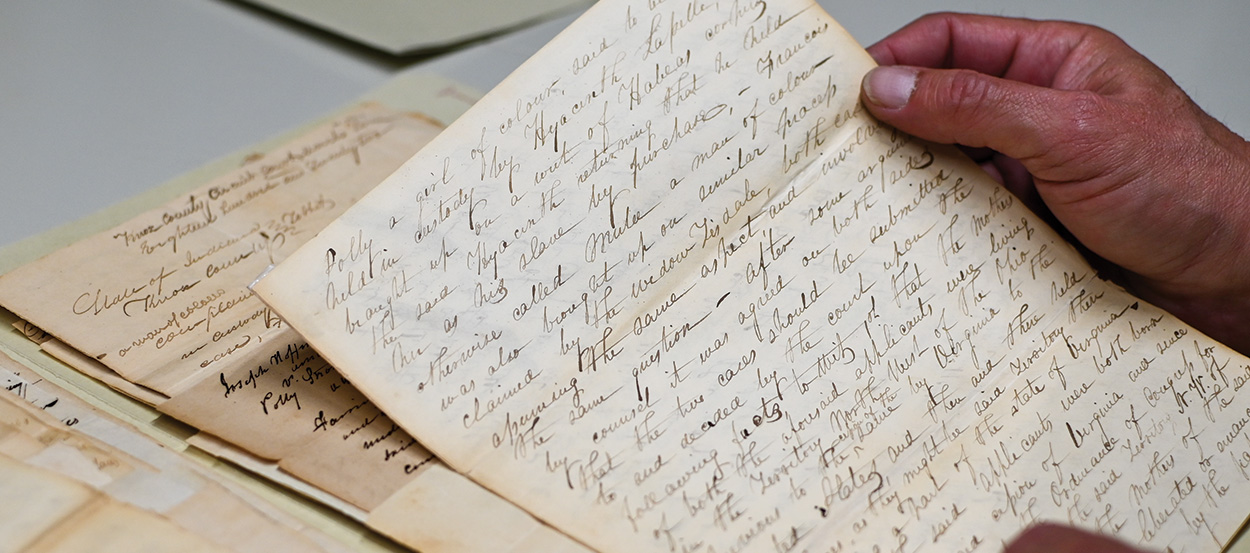
Polly Strong was born around 1796 to Jenny, an enslaved fifteen-year-old girl living in the part of the Northwest Territory that would become present-day Indiana. Although slavery was legally prohibited in the territory, Lasselle was able to purchase Polly from Joseph Baron in 1806, when Polly was around ten years old. Polly’s journey to freedom began when she was around 22 and can be traced through the handwritten documents uncovered in Knox County.
On July 15, 1818, Polly’s mother, Jenny, and attorney Moses Tabbs petitioned the Knox County Circuit Court for a writ of habeas corpus for Polly and her brother, James. Two days later, Hyacinthe Lasselle received a summons to present Polly and James before Judge Thomas H. Blake in order to certify the date and terms under which Polly and James entered into his servitude. On August 4, Lasselle responded with a document certifying that Polly and James “were, and are still, detained in [his] custody and possession, by virtue and under the following indenture.”
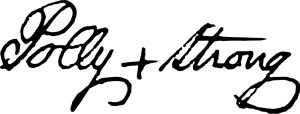
Later in the same document, the indenture gives a statement from Polly that indicates that she is “quietedly [sic] and contentedly in [Lasselle’s] employment.” However, Polly was unable to read and write, and it is likely that she signed this indenture under duress. Polly’s mark, a small cross she made between her first and last name, offers modern-day readers a direct connection to Polly. It stands as a powerful reminder of her humanity that is especially poignant in contrast with the rest of the document.
Unfortunately, the Knox County Circuit Court ultimately ruled in favor of Lasselle and remanded Polly to his custody. Undaunted, Polly and her attorney, Vermont-born abolitionist Amory Kinney, appealed the case to the Indiana Supreme Court in 1820. Among the uncovered documents is a handwritten copy of the opinion in the case, which had been authored by Justice James Scott on July 22, 1820. Even as a copy, this document is historically significant because it was written by Henry Coburn, the first Clerk of the Indiana Supreme Court. But of course, it was the content of the opinion that would change Polly’s life: the judgment of the Knox County Circuit Court was “in all things reversed, set aside, and held for nought.” Another document, bearing the seal of the Knox County Court, shows that Polly was awarded $500 in damages from Lasselle, presumably for back wages.
Now, these incredible historical artifacts are housed in the McGrady-Brockman House, the Knox County Public Library’s regional history and genealogy research center in Vincennes. In 2023, the Knox County Public Library was awarded a grant entitled “Stories Brought to Light: Black History in Knox County.” Provided by the Indiana Historical Society, this grant sought to uncover and digitize not only the Polly Strong documents, but also additional primary sources that speak to the extensive Black history of the area more broadly. It is through this grant that all of the documents discussed, and more, have been made digitally available on the Indiana State Library’s Indiana Memory archive. Anyone who accesses these documents can see how Polly made her mark—both literally and figuratively—in the case that determined that “slavery can have no existence in the state of Indiana.”
Access the Polly Strong documents on the Indiana Memory archive at on.in.gov/polly-strong.
Legal Disclaimer:
EIN Presswire provides this news content "as is" without warranty of any kind. We do not accept any responsibility or liability for the accuracy, content, images, videos, licenses, completeness, legality, or reliability of the information contained in this article. If you have any complaints or copyright issues related to this article, kindly contact the author above.
